04 / Heritage

How a site learns to represent a railway

No heritage bureau can place an entire railway network behind a fence.

Laurajane Smith’s Uses of Heritage begins from a deceptively simple claim: heritage is not a quality that old objects possess by themselves. Heritage is something people define.

By this standard, railways are especially difficult to fit into preservation systems because their significance and histories are dispersed across stations, cities, and local memories. No heritage bureau can place an entire railway network behind a fence.

Two images, two moments

A station in the archive and in the present

The older image is a photograph of a museum display, not a dated original negative. It shows a historic scene; its original maker and date still need verification.

Undated historic view of Bisezhai station with trains and tracks, photographed from a display in Gejiu Museum
Bisezhai station, historic view. Gejiu Museum display
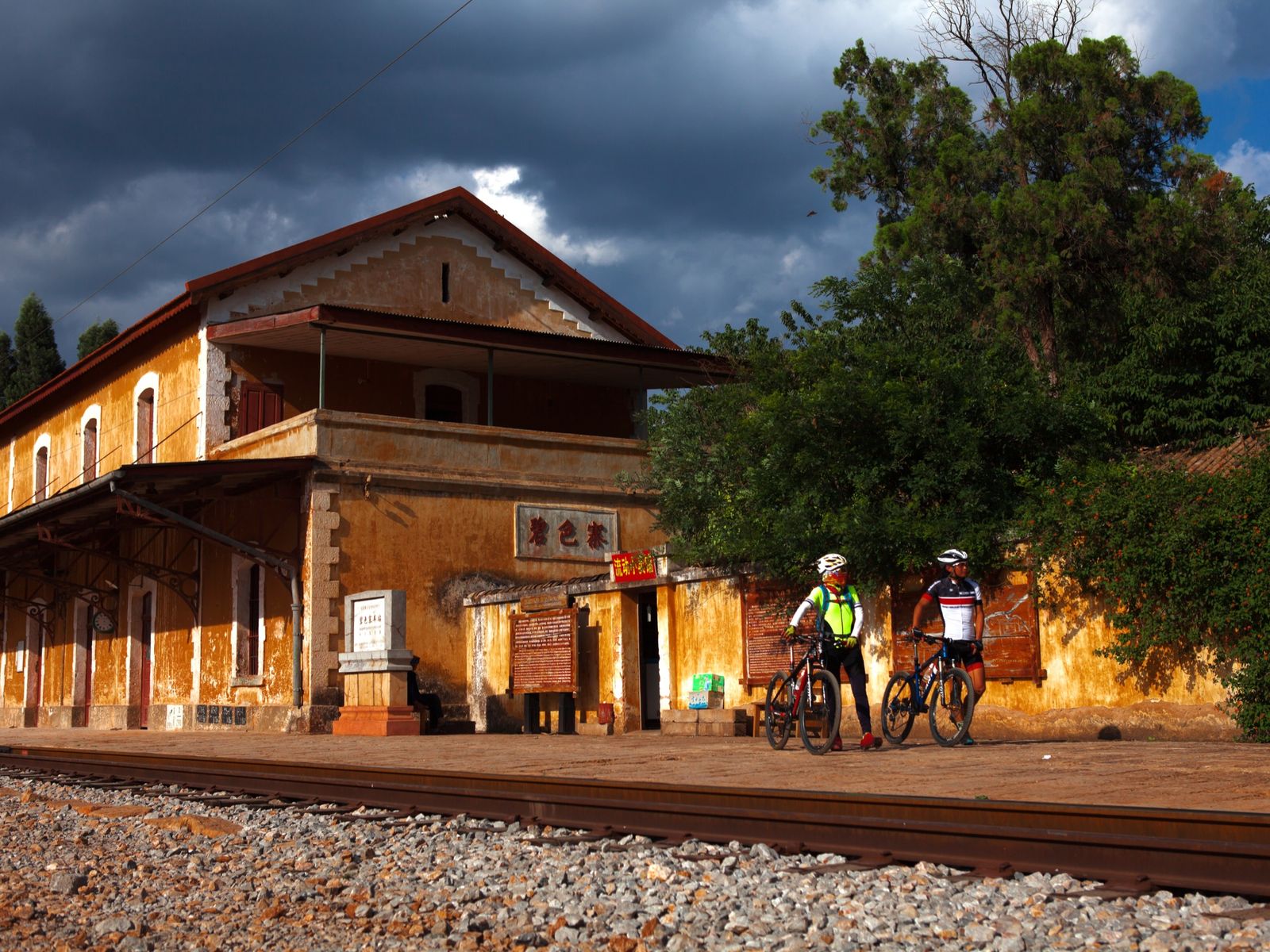
A contemporary view of Bisezhai station buildings and tracks published by The World of Chinese
Bisezhai station, contemporary view. Photograph by Hu Yan Hong, The World of Chinese, published 2021.

Beyond the station façade

A junction with several built histories

Bisezhai was a real transshipment node of the Yunnan–Vietnam Railway, especially important as the station where railways of different gauges met.

The older train photograph was reproduced in an architectural history study; its original photographer and exposure date have not been established. The interior photographs record surviving railway structures.

Archival view of a train beside Bisezhai's transfer building and station
Train and station, date unknown. Reproduced in Qiu Yi, Journal of Architectural History, 2023, fig. 5; cited there to Peng Huan's 2016 image collection.
Interior of a Bisezhai railway transfer building, showing timber structure and exhibition displays
Transfer building interior. Qiu Yi, 2023, fig. 6.
Interior roof structure of the Gejiu–Bisezhai Railway locomotive shed
Locomotive shed interior. Qiu Yi, 2023, fig. 7.

A sequence, not a single decision

How Bisezhai gained public reach

  1. 1987

    Protected as provincial heritage

    Bisezhai entered a formal system for recognizing historical structures.

  2. 2011

    Named a point of concentration

    During an inspection of Bisezhai’s development, a prefectural official described the Yunnan–Vietnam Railway as a linear resource whose dispersed form made cultural and tourism development difficult, and argued that Bisezhai could serve as the railway’s best “concentrated point” (Liu 2011). Inspect the reported visit

  3. 2013

    National designation

    The designations recognized historical structures and created an official route for visiting and interpreting the station.

  4. 2017–18

    Film and tourism promotion

    After the local government prepared Bisezhai to carry the railway’s image through reconstruction and protection projects, the 2017 film Youth introduced this image to a national audience. Mengzi’s 2018 government work report explicitly proposed using the film’s popularity to develop the historical and cultural park (Mengzi Municipal People’s Government 2018). Inspect the work report

  5. 2023

    A railway tourism core

    During the Fourteenth Five-Year Plan period, municipal planning aimed to position Bisezhai at the center of a wider railway heritage tourism belt (Mengzi Municipal People’s Government 2023). Inspect the plan

2016 / Before the film

Visitors were already here

This photograph documents visitors at Bisezhai in April 2016. The later film and government promotion expanded the site's reach; they did not mark the first arrival of tourists.

Visitors gathered under the canopy at Bisezhai station in April 2016
Visitors at Bisezhai station, April 3, 2016. Liu Ranyang / China News Service, via Xinhua.

Documents behind the timeline

When a station was made to stand for a line

Each record documents a stated proposal or plan at a particular date. The linked paper passages explain how those statements enter the argument.

2011 / Reported site visit

A “concentrated point”

A 2011 report demonstrated this logic. During an inspection of Bisezhai’s development, a prefectural official described the Yunnan–Vietnam Railway as a linear resource whose dispersed form made cultural and tourism development difficult, and argued that Bisezhai could serve as the railway’s best “concentrated point” (Liu 2011).

Liu Xia’s report in Time Weekly, republished by Sina on January 27, 2011, records the official’s proposal during a visit. It is a newspaper account of the proposal, not a planning decree.

2018 / Government work report

From film visibility to a park

Mengzi’s 2018 government work report explicitly proposed using the film’s popularity to develop the historical and cultural park (Mengzi Municipal People’s Government 2018).

The city’s report names the 2017 film Youth and the Bisezhai railway history park in its work for 2018. This is evidence of a development commitment, not proof that the work was completed that year.

2023 / Culture and tourism plan

A core for a wider route

During the Fourteenth Five-Year Plan period, municipal planning aimed to position Bisezhai at the center of a wider railway heritage tourism belt (Mengzi Municipal People’s Government 2023).

The published plan makes Bisezhai a core of its metre-gauge railway visitor route and names other connected places. Its language sets out an aim, not a historical ranking of stations.

From protection to public use

The work behind a recognizable place

The Yunnan Provincial Institute of Urban and Rural Planning's 2022 project account shows construction, streets, preserved buildings, and their new uses. The publication does not date each photograph separately.

01 / The physical work

From a station area to a visitor site

The planning account presents an aerial view labelled “before implementation” and photographs of timber roof work. Together they make the material work of protection visible.

Aerial view of Bisezhai before the project, with tracks, station buildings and surrounding houses
Site before implementation. Planning institute, 2022.
Two photographs of timber roof reconstruction at Bisezhai
Roof construction work. Planning institute, 2022.

02 / What gets selected

Streets and protected buildings

The paired street views show how visitors encounter a remade setting. The building group also extends beyond the station frontage.

Four paired views of Bisezhai streets before and after improvement work, labelled in Chinese
Streets before and after implementation. Planning institute, 2022.
Planning institute montage of three Bisezhai railway heritage buildings
Protected railway buildings. Planning institute, 2022.

03 / New uses

Exhibitions, visits, commerce

The institute presents exhibition and hospitality spaces among the new uses for old buildings. A railway-media photograph shows a tourist souvenir shop in the public setting that followed.

Colorful bags and souvenirs displayed at a Bisezhai shop
Souvenirs at Bisezhai. Kunming Railway, published 2024.
Nine-image planning institute montage showing exhibitions, hospitality and performance uses at Bisezhai
Building reuse and public programs. Planning institute, 2022. Swipe across the image to see all nine views.

04 / Interpretation

Someone still has to tell the story

A local volunteer explains the station to visitors. The setting is visible in a photograph, while the act of interpretation depends on people.

Local volunteer Shen Jiarong speaking with visitors along the Bisezhai station platform
Volunteer Shen Jiarong interpreting Bisezhai's history for visitors. Hu Wen / Mengzi Municipal Government, published 2025.

A symbol with a contested story

The red-clay court

The tale of the tennis court, for example, now has two competing narratives: one associated with government agencies and official experts, and one offered by the curator I met at the museum. I did not obtain any construction records or documents that could prove or disprove either account.

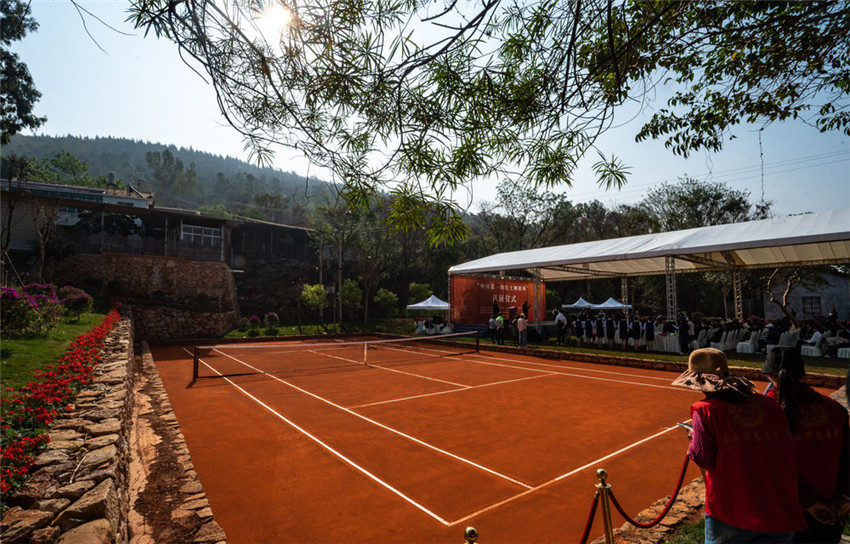
The 2023 sports authority account documents its official certification as the “first red-clay tennis court in China.” Certification does not, by itself, identify every worker who built the original court.

Bisezhai red-clay court overgrown before repair
Before restoration. Overgrown red-clay court; original exposure date not supplied. Xinhua, published 2023.
The red clay tennis court at Bisezhai photographed by Jiang Wenyao on March 30, 2023
Bisezhai red-clay tennis court, March 30, 2023. Photograph by Jiang Wenyao / Xinhua, State General Administration of Sport.

What becomes easy to see

Protection brought restoration and tourism planning; restoration created attractive settings for photography and drew visitors; visitors’ posts reinforced Bisezhai’s popularity and created economic incentives for further protection and restoration.

What takes work to explain

His private exhibition was an answer to that loss. By collecting tickets, photographs, letters, maps, tools, and architectural fragments, he had built a counter-archive of the railway and Kaiyuan.

Beyond one mistaken caption

Correcting one caption does not explain why some captions circulate widely while others remain unknown to the public. Trouillot directs attention to the unequal machinery that carries facts.

Next: the finding